
Prediction Markets See Major Midterm Boost Amid Growing Scrutiny

As midterm elections have been heating up, so have the prediction markets surrounding them. On Kalshi and Polymarket, traffic has been high, and while the markets have been around for a while, this is the first midterm in which they’re really mainstream. That has some experts sounding alarm bells, and some in the government have asked the markets to prove they’re not tainted.
Traffic rises for midterm elections
The numbers are a little dated, but as of October 23, over $1.4 billion had been traded on midterm elections, per CNN. For comparison, it is estimated that tens of billions have been traded on all sports in 2026. That is all major leagues as well as the World Cup, arguably the biggest sports competition in the world. While the midterms are seeing a fraction of that, it’s still a pretty sizable fraction.
The Anti-Corruption Data Collective published a report that there are 16 times as many midterm elections markets as in 2024. In the two years since the last election, prediction markets and what they offer in politics have grown exponentially.
“This is the biggest experiment that we ever had in American politics when it comes to prediction markets that are regulated in this way, that are open to the general public, that don’t have caps on betting,” said David Szakonyi, co-founder of ACDC.
Szakonyi also pointed out that implied probability from Kalshi and Polymarket are increasingly being reported alongside election news. Polling is no longer the only measure of political momentum being discussed. Much like sports betting odds, prediction market prices offer a constantly changing snapshot of public expectations, and election coverage is increasingly treating them as such.
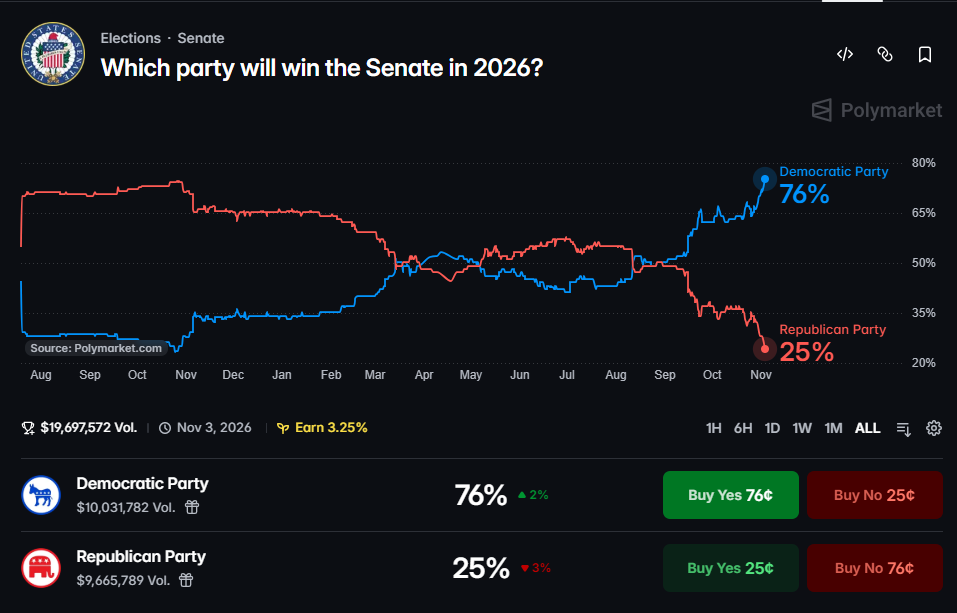
Image credit: Polymarket
Senators want proof of no corruption
Unlike traditional sportsbooks, prediction markets operate under a different regulatory framework, something that has some Senators concerned about the influence of election markets. That has some Senators concerned about the numbers at midterm elections. Democrat Elizabeth Warren and Republican John Curtis wrote a letter expressing concern.
“We are particularly troubled by election-related event contracts,” the senators said to Kalshi and Polymarket. “Event contracts tied to elections receive prominent coverage and are treated by some observers as indicators of political momentum.”
They are concerned that odds can be and are being manipulated to skew perception. They’re hoping the markets can prove that’s not the case as midterm elections heat up.
☑️ My Take
Two things can be true at once: midterm elections are exactly the kind of event prediction markets were designed to cover, but their growing influence also raises legitimate questions. These platforms are intended to offer people a way to engage with real-world events beyond sports, and politics is a natural extension of that. While it’s referred to as trading rather than betting, the underlying concept is similar. From a business perspective, offering election markets makes perfect sense.
However, it is also fair for government officials to be wary of these markets. While the percentages offer a snapshot of market sentiment, they should not be mistaken for facts or definitive indicators of what will happen. They reflect the collective expectations of those trading on the platforms, rather than necessarily being informed by any special access to information. They can be wrong, and while that uncertainty is part of what prediction markets are designed around, it is also a legitimate reason for scrutiny.
Cover image via ABC
 Zachary Roberts
 is an avid gamer and writer that loves to merge those things. He’s been featured on VideoGamer, ComicBook, New Leaf, Esports.net, and Sportskeeda as well as the On SI network of Sports Illustrated and Sporting News.
View full profileRead Also
 Kick
 Dota 2
 Kick
 News
 Dota 2
 News
 Twitch